
Data current: October 15, 2026 · Florida · 12 min read
Enrollment opens today. Medicare.gov has a free tool that will tell you, to the dollar, what each 2027 plan would cost you next year — your drugs, your pharmacy, your county.
Most people never get that number. Not because the tool is broken, but because it only works if you feed it four things, and it is perfectly happy to give you a confident-looking answer when you have skipped them.
I am Vivian Soto, an independent bilingual insurance agent at VS Healthcare Solutions in Orlando. This is the walkthrough, including the two steps almost everyone skips and the one screen where the wrong setting quietly costs money.
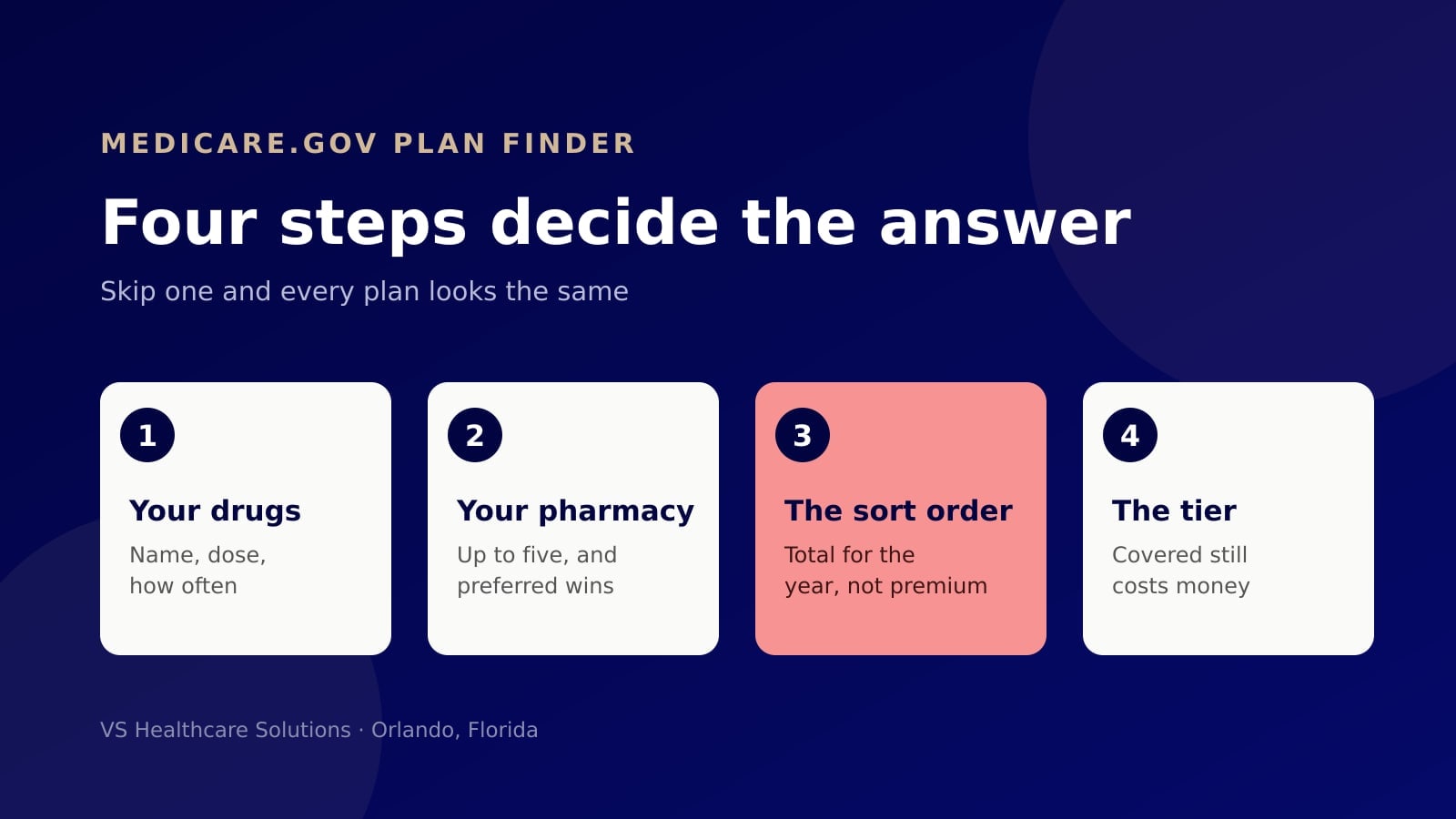
Step 1: your drugs, exactly as the bottle says
Go to Medicare.gov/plan-compare, choose whether you want a Medicare Advantage plan or a drug-only plan, and say yes when it asks whether to include drug costs.
Then enter every prescription. Not the ones you think matter — all of them.
For each one the tool asks for dosage, quantity and how often you fill it, and those details are not decoration. The same drug at a different dose can sit on a different tier, and quantity drives the whole year's arithmetic. CMS's own guidance is to copy this straight off the prescription bottle rather than from memory.
If you enter a brand name and a generic exists, the tool offers to swap it. Try it both ways. The difference between brand and generic is routinely the largest single number on the screen.
Why this step decides everything
Without a drug list, Plan Finder has nothing to estimate with, so it falls back to showing you premiums. Every plan then looks roughly the same and the cheapest-looking one wins. That is how people end up in a $0 plan that costs them thousands. The drug list is what turns a price list into an answer.
Step 2: pharmacies — and this is the step people skip
Next the tool asks for your pharmacies. You can add up to five.
Here is the part worth reading twice, because it comes straight from CMS and almost nobody acts on it: you do not have to pick the pharmacies you use today. Pick the ones you would be willing to use. CMS says so in its own instructions, because the pharmacy you choose changes the price.
Within one plan there are usually two kinds of in-network pharmacy:
| Pharmacy type | What it means for you |
|---|---|
| Preferred in-network | Usually the lowest copays the plan offers |
| Standard in-network | Covered, but often a higher copay for the same drug |
| Out-of-network | You can be left paying the full price |
Same plan, same drug, same day — different price depending on which door you walk through. Plan Finder lets you filter to show only preferred in-network pharmacies, and if yours is out of network it will offer to find one that is in.
Mail order is worth adding as one of your five, but do not assume it is cheaper. Sometimes it is, sometimes it is not, and the only way to know is to let the tool price it.
A practical Florida note: if you spend part of the year outside the state, add a pharmacy chain you can reach in both places and check that the plan prices it sensibly.
Step 3: the sort order, which is where money is quietly lost
Now you have a list of plans. Before you read a single number, look at how the list is sorted.
Plan Finder offers several sort options, including lowest monthly premium, lowest drug + premium cost for the year, and lowest yearly drug deductible. Only one of those answers the question you actually have.
I am not going to tell you which one is selected by default, because the guidance I can find disagrees and the interface has changed before. Check it yourself, every time. Set it to the total for the year and the ranking can reorder completely.
Why it reorders is simple arithmetic. A plan with a $0 premium and a $700 deductible that puts your drug on tier 4 will lose, over twelve months, to a plan charging $40 a month that puts the same drug on tier 2 with no deductible. The first plan wins every month until you fill the prescription.
Step 4: the tier, because “covered” is not a price
Click into a plan and look at how each of your drugs is actually treated. Covered is a yes-or-no. What you pay is the tier.
Most plans sort drugs into five or six tiers, roughly from preferred generics up to specialty drugs, and the gap between the bottom and the top is enormous. A drug can stay covered from 2026 to 2027 and still move up two tiers, which is a price increase that nobody announces.
While you are in there, look for three flags next to your drugs:
- Prior authorization — the plan must approve it before it pays
- Step therapy — you must try a cheaper drug first
- Quantity limits — the plan caps how much it covers per fill
None of these make a plan bad. All three are worth knowing in October rather than discovering at the counter in January.
The 2027 numbers the tool is working with
Two figures sit behind every estimate you will see this year, and both are set in law.
| Part D figure | 2026 | 2027 |
|---|---|---|
| Maximum deductible a plan may charge | $615 | $700 |
| Annual out-of-pocket cap — after this you pay $0 | $2,100 | $2,400 |
The deductible is a ceiling, not a standard — plenty of plans charge less and some charge nothing. The cap is the genuinely good news: whatever your drugs cost, covered Part D spending stops at $2,400 for the year, in every plan.
That cap also changes how you should read the comparison. If your prescriptions are expensive enough to reach $2,400, most plans land you in the same place by December and the question becomes how you get there. If they are not, the tier and the pharmacy decide your year.
What the tool cannot tell you
Plan Finder is good at arithmetic and blind to two things that matter.
Whether your doctor is really in the network for 2027. The directory shows what the plan last reported, and networks move. The only reliable check is to call the practice and ask which plans they will accept in 2027. Ask about the hospital your doctor admits to as well.
Whether your prescriptions will stay the same. The estimate assumes you take exactly what you entered, at those doses, all year. If something is likely to change, run the comparison a second time with the probable new drug and see whether the ranking survives.
And one honest limitation: the estimate is for a full calendar year. If you ever compare plans partway through a year, the figures cover only the months left.
Your calendar
| Date | What happens |
|---|---|
| October 15 | Enrollment opens. You can switch from today |
| November (expected) | CMS announces the 2027 Part B premium — still not published |
| December 7 | Enrollment closes. Your choice starts January 1 |
| January 1 – March 31 | If you hold a Medicare Advantage plan, one further change allowed |
There is no advantage to enrolling on day one. There is a large disadvantage to doing it on December 6, when the doctor's office you need to call is fielding everyone else who waited.
Frequently asked questions
Is the Medicare Plan Finder free?
Yes. It is the official tool at Medicare.gov/plan-compare, run by CMS, and it costs nothing. You can use it without an account, though logging in lets it save your drug and pharmacy lists so you do not re-enter them each visit.
Why do all the plans look the same when I compare them?
Almost always because no drug list has been entered. Without your prescriptions the tool has nothing to estimate, so it falls back to premiums and the plans look interchangeable. Add every drug with its dose and frequency and the spread between plans appears immediately.
Should I sort by premium or by total cost?
Total cost for the year. The premium is one of several numbers you pay and often the smallest. Check which sort is applied before reading the results, because the ranking changes substantially between the two.
How many pharmacies should I add?
Up to five, and CMS specifically suggests including ones you would be willing to use rather than only the one you use now. Pharmacy choice changes the price within the same plan, so adding a couple of alternatives is how you find the cheaper option.
What is the difference between a preferred and a standard pharmacy?
Both are in-network, but preferred in-network pharmacies usually offer the lowest cost for your drugs. The same prescription under the same plan can cost noticeably more at a standard in-network pharmacy.
My drug is covered. Why is it still expensive?
Because covered is a yes-or-no and price is set by the tier. A drug can remain on the formulary and move to a higher tier for 2027, which raises what you pay without ever being described as a change in coverage.
What are the 2027 Part D deductible and out-of-pocket cap?
The maximum deductible a plan may charge is $700, up from $615. The annual out-of-pocket cap is $2,400, up from $2,100 — once your covered drug spending reaches it you pay nothing more for covered Part D drugs that year.
Does using an agent cost more than enrolling myself?
No. Agent commissions are built into plan premiums whether you enrol on Medicare.gov or with help, so your premium is identical either way. If you would rather not use an agent at all, Florida's SHINE program gives free, unbiased counselling at 1-800-96-ELDER.
An hour now, or a year of the wrong plan
Done properly for someone on five or six prescriptions, this is about an hour of work and a few phone calls. Done in the first week of December, it is guesswork.
The households I see save the most are not the ones who found a clever plan. They are the ones who entered their drugs honestly, checked the pharmacy, read the tier, and then discovered their current plan was fine after all — or that it had quietly stopped being fine. Either answer is worth an hour.
You can see how we help with Medicare, or reach me directly.
- Centers for Medicare & Medicaid Services. “Adding Drugs & Pharmacies When Shopping for Plans” (publication 12075-P) — entering dosage, quantity and frequency; selecting up to five pharmacies; the guidance to choose pharmacies you would be willing to use; filtering to preferred in-network pharmacies, which usually offer the lowest cost for drugs.
- Medicare.gov Plan Finder — Medicare.gov/plan-compare; 2027 plan data available from 1 October 2026.
- Centers for Medicare & Medicaid Services. Contract Year 2027 Medicare Advantage and Part D benefit parameters — $700 maximum deductible and $2,400 annual out-of-pocket threshold for 2027, against $615 and $2,100 for 2026.
- Sort options described in State Health Insurance Assistance Program walkthroughs of Plan Finder: lowest monthly premium, lowest drug + premium cost for the year, and lowest yearly drug deductible. Published guidance disagrees on which is applied by default, so this article tells readers to check rather than asserting one.
- Centers for Medicare & Medicaid Services. Medicare Advantage and Part D open enrollment, 15 October to 7 December 2026, for coverage beginning 1 January 2027.
- Florida Department of Elder Affairs. SHINE program, 1-800-96-ELDER.